
Platform comparison
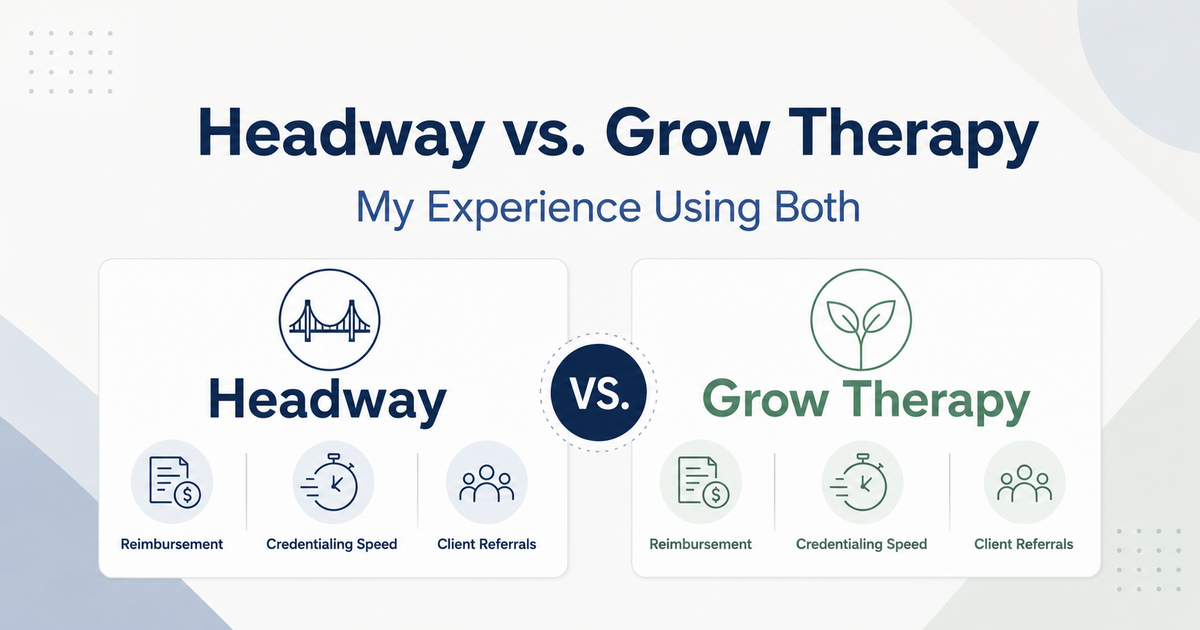
Headway vs. Grow Therapy: 10 Differences (I Use Both)
Short answer
Headway fits licensed therapists who bring referrals and value its rates and billing support. Grow fits licensed therapists who want more marketplace referrals and integrated tools. In Florida, both require full licensure, so registered interns cannot join yet.
In my Florida practice, Headway has generally offered higher reimbursement, while Grow has produced more referrals and faster initial paneling. I use both. These are personal observations, not promises about another clinician’s results.
Before comparing offers, ask can registered interns join either platform in Florida?
By Gabriel Benaim, LMHC | Last reviewed October 5, 2026
Which platform may fit?
Compare your written rates, payer access, referral results and workflow needs in the table below. Use the decision checklist before committing to one platform or combining them.
Experience note: My observations reflect one Florida LMHC practice, not universal results.
Before you read further
For their Florida independent-provider networks, both platforms require full licensure. If you are a registered intern, neither is open to you yet, and the comparison below is something to file away rather than act on. The part you can control during supervision is whether your hours clear the Board the first time.
Headway vs. Grow Therapy comparison
| Factor | Headway | Grow Therapy |
|---|---|---|
| Primary role | Insurance enablement and practice tools | Insurance, referrals, and practice tools |
| Florida licenses accepted | ARNP, CADC with another active license, LCSW, LMFT, LMHC, MD/DO, psychologist, telehealth license | LP, LMHC, LCSW, LMFT, PMHNP, MD/DO |
| Provider cost | No advertised setup, subscription, or credentialing fee | Verify current terms directly |
| Credentialing | Approval in 3 weeks to 4 months, plus up to 8 weeks for insurers to set up payment | About 5 to 7 days with Grow, then payer enrollment of 2 months or more |
| My paneling | Slower | First payer in about one week |
| Payout cadence | Twice monthly | Every Friday, funds in 1 to 3 business days |
| Collection risk | Cancellation fee paid only after collection from the client | Insurance payouts guaranteed even if Grow cannot collect, excluding cash pay and no-shows |
| Contract ownership | Credentialed under Headway’s own payer agreements; exit terms not published | Credentialed under Grow’s group contracts; enrollment does not transfer out |
| My reimbursement | Generally higher | Generally somewhat lower |
| My referrals | Few direct referrals | Considerably more referrals |
| Tools | Scheduling, EHR features, telehealth, claims, payments | Scheduling, EHR, telehealth, referrals, claims, payments |
| Cancellations | Provider policy; fee paid after collection | Provider fee within platform and payer limits |
| Best use for me | Billing clients found elsewhere | Referrals plus insurance administration |
10 differences to evaluate
1. Accepted licenses and payer access
Both platforms require full licensure, so neither is open to you during supervision. In Florida, Headway credentials ARNP, CADC alongside another active clinical license, LCSW, LMFT, LMHC, MD/DO, and psychologists, and Florida is the only state where Headway accepts a telehealth license. Grow credentials LP, LMHC, LCSW, LMFT, PMHNP, and MD/DO. Past the license itself, compare your exact plan products rather than national carrier logos, because being in network with a carrier and being in network with the specific product your client carries are two different things.
Headway location limitation: Headway says providers may conduct sessions only while physically within the United States. This is a provider-location restriction in addition to the client-location, licensure, and credentialing requirements.
2. Rates
My Headway rates are generally higher. Neither company publishes a rate card, and neither sets one number nationally: rates move with payer, state, license, and CPT code, so the only figure that describes your situation is the one in your own offer. Compare common CPT codes, service mix, cancellations, referrals, and administration rather than a single session rate.
3. Credentialing speed
This is the clearest documented difference. Grow puts its own credentialing at an average of five to seven days, with payer enrollment then typically taking two months or more and in rare cases past six. Headway puts approval at three weeks to four months, and insurers generally take up to a further eight weeks to load you into their payment systems. My first Grow payer was faster, which matches those published ranges rather than contradicting them. Neither is a guaranteed income date. Grow also requires individual malpractice coverage of at least $1M per occurrence and $3M aggregate.
4. Referrals
Grow has produced more referrals for me. This can differ by market, specialty, payer mix, profile, and availability. Track retained clients, not inquiries alone.
5. Payment cadence
Grow initiates payouts every Friday morning Eastern, with funds typically landing one to three business days later and a Thursday 7pm Eastern cutoff for that week’s run. Insurance claims take roughly 14 to 21 days to process before they reach a payout. Headway describes twice-monthly payments. If you are newly licensed and still building a caseload, weekly against twice-monthly is a larger difference than it sounds, because it decides how long you float your own expenses.
6. Who carries the collection risk
This is the item I would look at hardest, and it is the one most comparisons skip. Grow states that it guarantees insurance payouts even when it cannot collect from the insurer, though that guarantee does not extend to cash-pay sessions or no-shows. Headway pays a cancellation fee to the provider only after it collects from the client. The real question is not what each platform charges, it is who absorbs the loss when a claim or a client does not pay.
7. Calendars
Both offer scheduling workflows. Headway says existing-client direct booking is turned on by default for clinicians who joined on or after April 9, 2026; it can be disabled under Settings → New Clients → Existing client direct booking. If using both platforms, choose an authoritative calendar and audit availability, direct-booking settings, and recurring appointments to prevent double-booking.
8. Documentation
Both connect records to billing. Compare note types, deadlines, corrections, audits, discharge, and export access, and confirm before you join that you can export your own records in a usable format rather than only reading them inside the portal.
9. Contract ownership and exit
Neither platform hands you portable insurance panels. Both credential you under their own group contracts with payers, so the participation belongs to the company rather than to you. Grow says this plainly: your enrollment status will not transfer outside of Grow. Headway does not publish its exit terms, which is worth knowing in itself. What you keep either way is your own credentialing file, above all a current and attested CAQH profile. What you do and do not own covers what that means in practice.
10. Referral concentration
Do not depend entirely on either company. My current mix is about 40% Psychology Today, 35% Grow, 10% Headway, and 15% other sources. Diversification protects continuity.
Provider location and international travel
Provider location: Grow’s July 30, 2026 guidance says sessions must be conducted from within the United States and permanent or indefinite residence abroad is incompatible with active Grow practice. It also describes a U.S. military-base exception and says temporary travel abroad of less than two months may be possible after verifying licensing, malpractice coverage, privacy, and client-safety requirements.
Unresolved wording: The same article does not clearly reconcile its temporary-travel language with its general within-the-U.S. requirement. Degree to License recommendation: Obtain case-specific written confirmation from Grow before conducting any Grow session while abroad. Do not treat temporary foreign practice as automatically authorized.
Which may fit better?
Headway may fit better if
- Your offered rates and payer access are stronger
- You already generate referrals
- You mainly want insurance administration
Grow may fit better if
- Referral generation is a priority
- Its payer mix fits your clients
- You want an integrated referral and practice system
The comparison that matters is the one you run yourself
Contracted rates vary by state, license type, payer and CPT code, so no published table is honest. The Clinician Pay Guide gives you the formulas instead, so that when you have a real rate sheet you can tell whether it is good.
Can you use both?
I do. Confirm both agreements and payer rules, assign each client to one billing pathway, prevent duplicate claims, coordinate calendars, and know which system contains the controlling record. More platforms also mean more messages, policies, tax records, and exit work.
Decision checklist
- □ Plan-level payer access and common CPT rates
- □ Retained referrals rather than inquiries
- □ Credentialing timeline and financial runway
- □ Payments, denials, cancellations, and recoupments
- □ Scheduling, telehealth, notes, and exports
- □ Termination and client-transition terms
- □ Contractor taxes, malpractice, technology, and unpaid administration
- □ At least one referral channel you control
My conclusion
Work through your own rates, referral results and contract terms before choosing. The decision checklist above includes the administrative and exit questions to settle alongside the financial comparison.
Read the full reviews
Comparing more than two services? See 7 platforms for therapists compared for insurance-support services, directories, and booking marketplaces.
Headway for therapists, Grow Therapy for therapists, Psychology Today for therapists, W-2 vs. 1099 therapist, and Florida therapist pay.

Explore Headway
I may earn a commission if you sign up through this link, at no additional cost to you. I use Headway and include limitations alongside benefits. Terms can change.
Review Headway’s current offer
Explore Grow Therapy
I may earn a commission if you sign up through this link, at no additional cost to you. I use Grow and include limitations alongside benefits. Terms can change.
Review Grow Therapy’s current offer
About the author
Gabriel Benaim is a Florida Licensed Mental Health Counselor. He uses both platforms and separates firsthand observations from official platform information.
Next: compare your own platform numbers
Use the free Clinician Pay Guide with the rates, expected sessions and costs that apply to your practice. Get the free Pay Guide →
Get updated when major therapist platforms change. Join the DegreeToLicense updates list for occasional updates about material changes to fees, eligibility, insurance participation, and provider terms.
Official information reviewed
- Headway for Providers
- Headway credentialing
- Headway payments
- Headway cancellations
- Headway licensing and location requirements
- Headway provider profile and direct-booking settings
- Grow for Providers
- Grow credentialing
- Grow cancellations
- Grow policies
Professional and informational disclaimer: This article is educational and is not legal, tax, billing, compliance, financial, or clinical advice. Platform features, payer participation, rates, and contracts can change. Verify current terms for your license, state, payers, and practice.
Frequently asked questions
Is Headway or Grow Therapy better for therapists?
Neither is a universal winner. In my Florida practice, Headway’s rates were generally higher, while Grow sent more referrals. Compare your own payer rates, referrals, tools, and contract terms.
Can Florida registered interns join Headway or Grow?
Not as independent providers in Florida under the current listed license types. Both pages describe full licensure as the entry point. Recheck the platforms’ rules when your LMHC license is issued.
Which platform pays therapists more often?
Grow initiates eligible payouts on Fridays, while Headway pays twice a month. The date you can receive a specific insurance payment also depends on claim processing and eligibility.
Can therapists use Headway and Grow together?
Yes, if the agreements allow it and you can keep each platform’s clients, claims, records, and calendars separate. Compare the full economics before dividing your work between them.